
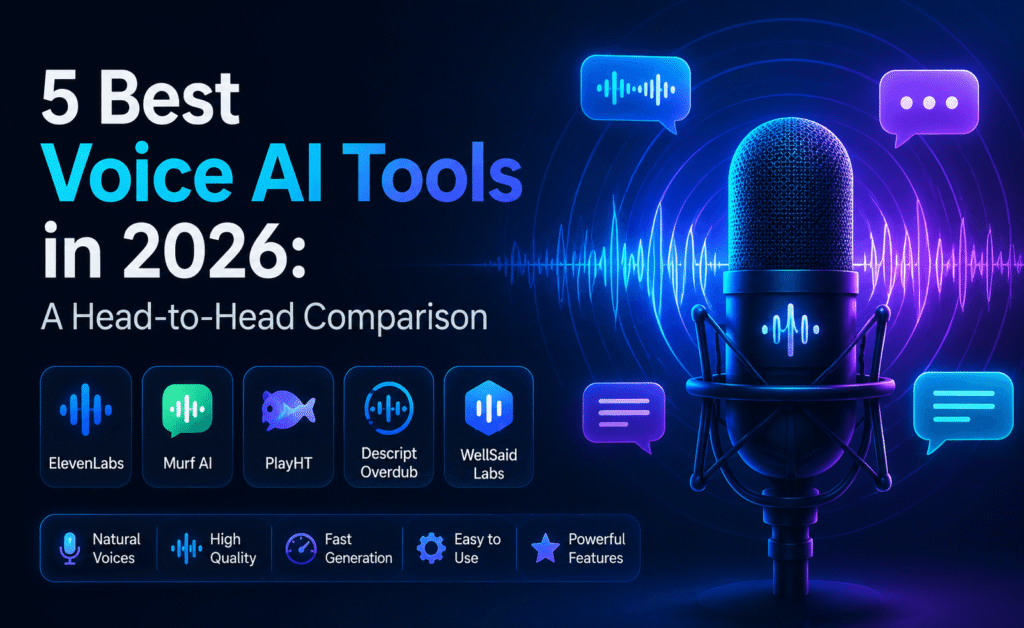
5 Best Voice AI Tools in 2026: A Head-to-Head Comparison
We compare the top 5 voice AI platforms of 2026 — ElevenLabs, Murf.ai, Play.ht, WellSaid Labs, and Resemble AI — to help you pick the right one.
5 Best Voice AI Tools in 2026: A Head-to-Head Comparison
Choosing a voice AI platform used to mean picking whichever tool made the most convincing demo video. In 2026, the market has matured enough that the real differences show up in the details — pricing structure, API reliability, language coverage, and how well a tool fits your specific workflow. After testing the leading platforms individually, we put them side by side to help you find the right match faster.
Our Testing Methodology
To keep this comparison grounded rather than purely impressionistic, we evaluated each platform against the same core criteria: voice realism across both short and long-form scripts, ease of onboarding for a first-time user, depth and reliability of the developer API, breadth of language and accent coverage, and overall value relative to price. We also weighed how each platform handled edge cases — technical jargon, brand names, and non-English content — since those situations tend to expose the gap between a polished demo and genuinely dependable production software.
None of these platforms is objectively “better” across every single dimension; the right choice depends heavily on what you’re actually building and how your team already works, which is why this comparison leans on specific use cases rather than a single overall ranking. We updated our hands-on notes for this roundup after retesting each platform’s most recent model updates, so the observations below reflect current performance rather than older reviews still circulating elsewhere.
The Contenders
This roundup compares five platforms we’ve reviewed in depth on Tedony: ElevenLabs, Murf.ai, Play.ht, WellSaid Labs, and a fifth category-defining option worth watching, Resemble AI, known for its real-time voice cloning and conversational voice applications.
Quick Comparison
| Platform | Best For | Voice Realism | Ease of Use | Pricing Tier |
|---|---|---|---|---|
| ElevenLabs | Expressive storytelling & dubbing | Excellent | Moderate | Premium |
| Murf.ai | Business & training videos | Very Good | Excellent | Mid-range |
| Play.ht | Content-to-audio & developer API | Very Good | Good | Mid-range |
| WellSaid Labs | Enterprise brand consistency | Excellent | Good | Premium |
| Resemble AI | Real-time & conversational voice | Very Good | Moderate | Usage-based |
1. ElevenLabs — Best for Expressive, Story-Driven Content
ElevenLabs remains the platform to beat when the script demands genuine emotional performance — audiobooks, game characters, film dubbing, and narrative podcasts. Its speech-to-speech feature and large voice library give creators exceptional flexibility, though the premium pricing and steeper learning curve on advanced features mean it’s best suited to teams that will use those capabilities regularly rather than occasionally.
2. Murf.ai — Best for Business and Training Content
If your priority is producing professional-sounding voiceover quickly, without hiring an audio specialist, Murf’s built-in timeline editor and shallow learning curve make it the easiest platform on this list to onboard a whole marketing or L&D team onto. It trades some emotional range for usability — a fair trade for most corporate use cases.
3. Play.ht — Best All-Around Value
Play.ht doesn’t dominate any single category, but it’s consistently strong across the board: solid voice realism, a genuinely useful web-to-audio converter, and a dependable developer API, all at a reasonable price. It’s the platform we’d point a generalist toward — someone who needs good voice AI without narrowing down to one specific use case first.
4. WellSaid Labs — Best for Enterprise Brand Consistency
For large organizations producing high volumes of training or internal content, WellSaid’s curated voice library, pronunciation controls, and custom brand-voice program solve problems that matter more at scale than raw voice-library size does. It’s a premium enterprise tool, and it’s priced and positioned like one.
5. Resemble AI — Best for Real-Time and Conversational Voice
Resemble AI has carved out a strong niche in low-latency, real-time voice generation — the kind of technology behind interactive voice agents, live dubbing, and conversational AI applications. Voice quality is strong, and the real-time performance is genuinely impressive, though it’s more infrastructure-oriented than the other tools here, making it best suited to development teams building voice into a live product rather than content creators producing pre-recorded audio.
How to Choose the Right One
- You need expressive, emotional narration: ElevenLabs
- You need fast, professional business videos: Murf.ai
- You want to convert written content into audio and need a reliable API: Play.ht
- You’re an enterprise team that needs a consistent brand voice at scale: WellSaid Labs
- You’re building a real-time voice agent or interactive product: Resemble AI
What’s Changing in Voice AI Right Now
A few trends stood out across all five platforms during testing this year. Latency continues to drop, making real-time conversational voice increasingly viable for customer-facing applications. Multilingual quality is converging — the gap between top-tier English output and other major languages is narrowing noticeably compared to a year ago. And licensing and consent frameworks around voice cloning have matured across the board, with most major platforms now requiring clearer verification steps before enabling cloning of a real person’s voice — a welcome shift as the technology becomes more accessible.
Pricing Snapshot
Pricing structures vary meaningfully across these platforms, and the “cheapest” option depends heavily on how you actually use it. ElevenLabs and WellSaid Labs both sit at the premium end, though for different reasons — ElevenLabs charges for its voice realism and flexibility, while WellSaid charges for consistency, governance, and enterprise support. Murf.ai and Play.ht occupy the mid-range, with Murf’s pricing built around minutes of generated audio and Play.ht’s scaling more directly with character or word usage. Resemble AI’s usage-based model can be extremely cost-effective for bursty, real-time workloads but requires more careful monitoring to avoid unexpected costs at scale.
Our general recommendation: start with each platform’s free tier or trial before committing to an annual plan. Voice quality is subjective enough — and workflow fit matters enough — that a short hands-on test with your own scripts will tell you more than any comparison table.
Integration and Workflow Considerations
Beyond raw voice quality, how a platform fits into your existing workflow often ends up mattering just as much. Teams already working inside a video editor may lean toward Murf.ai simply because it removes an export/import step. Developers building a product feature will care far more about API latency, documentation quality, and streaming support — areas where Play.ht, ElevenLabs, and Resemble AI all perform well, each with slightly different strengths. Enterprises with legal and compliance review as part of their procurement process should weight WellSaid’s governance tooling more heavily than they might for a smaller, faster-moving team.
It’s also worth considering how often you’ll actually need advanced features like voice cloning or multilingual dubbing. A platform that excels at those specific capabilities but adds friction to your everyday workflow may end up being a worse fit than a slightly less flashy tool that matches how your team actually works day to day.
Frequently Asked Questions
Which voice AI tool has the most realistic voices overall? ElevenLabs and WellSaid Labs both rank at the top for realism, though they optimize for different things — ElevenLabs for expressive range, WellSaid for polished consistency.
Which tool is easiest for a complete beginner? Murf.ai generally has the shallowest learning curve thanks to its all-in-one editor and template-driven workflow.
Which platform is best for developers building a voice-enabled product? Play.ht, ElevenLabs, and Resemble AI all offer strong APIs; Resemble AI in particular stands out for real-time, low-latency use cases.
Do any of these tools offer a free trial? Most of the platforms in this comparison offer either a free tier or a trial period, making it worth testing two or three directly against your own scripts before subscribing.
Common Mistakes When Choosing a Voice AI Tool
The most frequent mistake we see teams make is choosing a platform based on a single impressive demo clip rather than testing it against their own real content — dramatic movie-trailer-style samples rarely reflect how a tool performs on a technical training script or a fifteen-minute audiobook chapter. A close second is underestimating ongoing usage volume and landing on a pricing tier that looks affordable in month one but becomes expensive at scale. And organizations occasionally overlook licensing terms entirely, only to discover after publishing content widely that their plan didn’t include the commercial usage rights they assumed were standard. Reading the fine print on licensing and testing with your actual scripts before committing will save far more time than comparing marketing pages alone, and it’s a habit worth building regardless of which platform ultimately wins out for your team.
Final Thoughts
There’s no single “best” voice AI tool in 2026 — there’s a best tool for your specific use case. Creators chasing emotional realism should start with ElevenLabs; businesses that need speed and simplicity will be happiest with Murf.ai; generalists and developers get excellent value from Play.ht; enterprises prioritizing consistency should look hard at WellSaid Labs; and teams building real-time voice products should have Resemble AI on their shortlist. Whichever you choose, the overall bar for voice AI quality has risen enough that it’s genuinely hard to go wrong — the differences now live in workflow fit, not basic competence.
Bottom line: Match the tool to your workflow, not the other way around — every platform on this list can produce excellent audio when used for what it’s actually built for.