

Geneva’s AI Moment: Inside the UN’s First Global Dialogue on AI Governance
For two days in July, all 193 UN member states sat at the same table to talk about artificial intelligence for the first time. It produced no treaty and no binding rules — but it may have quietly established the forum where those eventually get written.
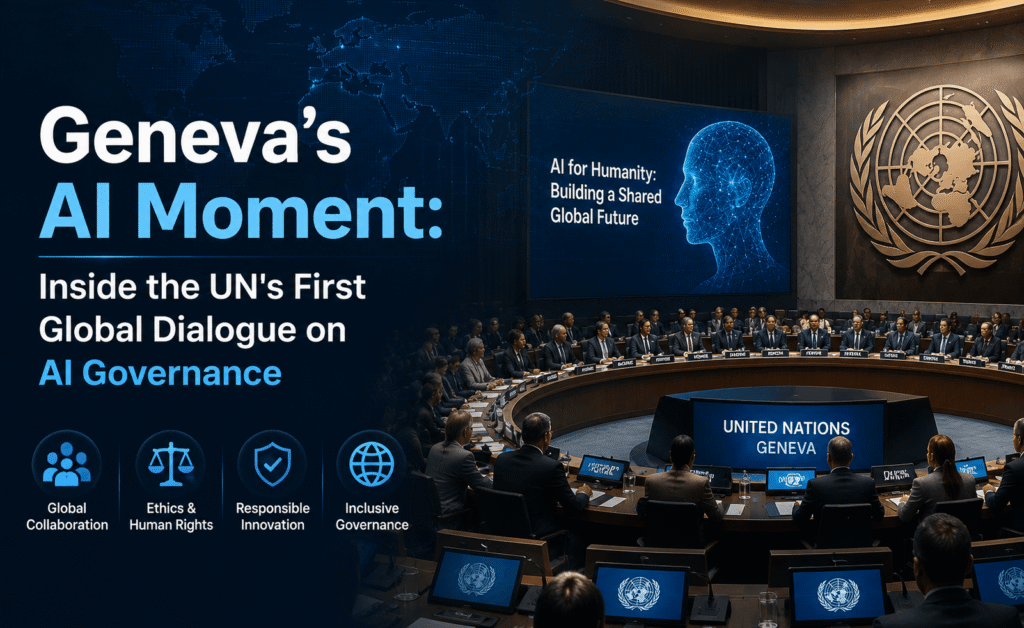
On July 6 and 7, delegates from all 193 United Nations member states gathered at the Palexpo convention center in Geneva for something that had never happened before: a single, universal, multi-stakeholder forum dedicated entirely to artificial intelligence governance, convened directly by the UN General Assembly rather than by a coalition of the wealthiest or most technologically advanced nations. The inaugural Global Dialogue on AI Governance produced no binding treaty and no enforceable rules. What it did produce was something harder to measure but potentially more consequential: a permanent, recurring venue where the rules of the road for AI might eventually get negotiated, with every country in the room rather than a select handful.
Why this dialogue, and why now
The Dialogue’s legal basis traces back to General Assembly Resolution 79/325, which identified seven thematic pillars for international AI cooperation: safe, secure and trustworthy AI; capacity-building for developing nations; the social, economic, ethical, cultural, linguistic and technical implications of AI; interoperability across different national governance approaches; the protection and promotion of human rights; transparency, accountability and human oversight; and open-source software, open data and open AI models. Those seven pillars structured the sessions in Geneva, running from a high-level governmental plenary through breakout, multistakeholder discussions organized around the same thematic clusters.
The choice of co-chairs was deliberate and symbolic. Rather than pairing a major AI power with another major AI power, the UN selected Ambassador Egriselda López of El Salvador and Ambassador Rein Tammsaar of Estonia — envoys from two smaller states, explicitly signaling that this forum was not going to be dominated by the handful of countries that currently build frontier AI systems. Secretary-General António Guterres and General Assembly President Annalena Baerbock opened the proceedings, and Guterres used the opening session to lay out four concrete priorities for international action: establishing common safety standards for testing and measuring AI risk, drawing clear red lines grounded in existing human-rights law, building meaningful AI capacity in developing countries — including a proposed Global Fund for AI — and improving transparency around AI’s environmental footprint.
The timing was not incidental either. The Dialogue ran back-to-back with two other major Geneva gatherings — the International Telecommunication Union’s AI for Good Global Summit, now in its seventh year, and the World Summit on the Information Society Forum — creating what organizers openly billed as a “Geneva Digital Week.” A single media accreditation covered all three events, and registration for the Dialogue itself closed in late June after drawing government, private-sector, academic and civil-society participants under a strict credentialing process designed to keep the forum genuinely multistakeholder rather than dominated by any one constituency.
The other half of the machine: an independent scientific panel
The Dialogue was designed from the outset as one half of a two-track system the General Assembly built to give AI governance a durable institutional home at the UN. The diplomatic forum — the Dialogue itself — sits alongside an Independent International Scientific Panel on Artificial Intelligence, whose first report was presented in Geneva alongside the Dialogue’s opening sessions. Panel co-chair Yoshua Bengio, one of the field’s most prominent researchers, used the occasion to warn that AI is approaching or already surpassing human capability across a growing range of domains — a framing intended to underscore the urgency behind the Dialogue’s work, even as the forum itself moves at the deliberately unhurried pace typical of UN consensus-building.
That urgency was echoed by other participants speaking around the summit, including journalist and Nobel laureate Maria Ressa, who joined Bengio and López in briefings ahead of the meeting. A recurring theme across those conversations was the gap between AI’s rate of adoption among the world’s most vulnerable users — Guterres specifically flagged that millions of children worldwide are already using AI systems to learn, solve problems, and seek advice about deeply personal concerns — and the pace at which safeguards have kept up with that adoption. It is a concern that echoes, almost precisely, the wave of state-level chatbot safety legislation moving through US legislatures this year, suggesting the child-safety dimension of AI governance has become a genuinely global, rather than regional, preoccupation.
The Dialogue is explicitly designed as a recurring institution rather than a one-off summit. A second session is already scheduled for May 2027 in New York, timed to run alongside the Multistakeholder Forum on Science, Technology and Innovation for the Global Goals, establishing a roughly annual cadence that will alternate between the UN’s Geneva and New York hubs. Organizers have been careful to frame the July session as cumulative rather than conclusive — the beginning of a process of building shared understanding across governments and stakeholders that can eventually inform concrete governance decisions, not a venue expected to produce binding outcomes on its first outing.
The G7’s parallel — and narrower — track
The UN’s universal forum is not the only venue where AI governance commanded serious attention this summer. Weeks earlier, the 2026 G7 Summit in Évian-les-Bains, France, placed AI governance at the center of its agenda, bringing together heads of government with executives from the industry’s most influential companies, including Sam Altman of OpenAI, Demis Hassabis of Google DeepMind, and Dario Amodei of Anthropic. Where the UN Dialogue is explicitly designed to be universal and slow-moving by construction, the G7 forum represents the opposite instinct: a small, like-minded grouping of advanced economies working directly with the companies actually building frontier systems, discussing AI safety, regulatory alignment, infrastructure investment and international cooperation in a format that can move considerably faster than a 193-member UN process ever could.
The two tracks are not in competition so much as they represent two different bets about how international AI governance will actually get built. The G7’s approach bets that meaningful coordination has to start among the countries and companies with the most advanced capabilities, with broader international buy-in following later. The UN’s approach bets that legitimacy — and eventual global compliance — requires every country to be in the room from day one, even if that means moving more slowly and settling for thematic dialogue rather than binding commitments in the near term.
What actually changed, and what to watch next
Skeptics of the Geneva session have a fair point: the Dialogue produced no treaty, no enforcement mechanism, and no binding commitment from any of the 193 governments that attended. Judged purely against the standard of “did this produce a rule,” the answer is no. But judged against the standard of institution-building, the Dialogue accomplished something that had eluded the international community since generative AI’s emergence — it established, for the first time, a standing, universal, recurring forum where every UN member state, not only the wealthiest or most technologically advanced, has a formal seat at the table on AI governance, backed by an independent scientific body producing regular risk assessments.
The real test will come at the second session in New York in May 2027, and at whatever national legislation and regulatory guidance emerges from the four priorities Guterres laid out in his opening remarks — common testing standards, human-rights-grounded red lines, a capacity-building fund for developing nations, and environmental transparency. Whether the Dialogue evolves into a forum that actually shapes binding national policy, the way earlier UN processes eventually shaped climate and human-rights law, or whether it settles into a recurring but largely symbolic gathering, will not be clear for another year or more. What is already clear is that, as of this July, the conversation about who gets to govern artificial intelligence has formally and permanently expanded beyond the small club of nations that build it.
The capacity gap the Dialogue is trying to close
One thread ran through nearly every session in Geneva more consistently than any other: the growing divide between countries that can build and audit frontier AI systems and countries that can only receive them. Guterres’s proposed Global Fund for AI is a direct response to that gap, aimed at giving developing nations the technical capacity to evaluate AI risk on their own terms rather than relying entirely on assessments produced by the handful of countries and companies developing the most advanced systems. Delegates from smaller and lower-income member states used the breakout sessions on capacity-building to press a consistent argument: that a governance framework designed primarily by, and for, the handful of nations building frontier models risks producing rules that simply do not fit the realities of countries still working to build basic digital infrastructure, let alone AI oversight capacity.
This is precisely why the choice of co-chairs mattered as much as it did. By placing El Salvador and Estonia — rather than, say, the United States, China or a major EU member state — at the head of the table, the UN signaled that the Dialogue’s legitimacy depends on being seen as genuinely representative rather than another venue where a handful of powerful states set terms that everyone else is expected to ratify.
Where global AI governance goes from here
The next twelve months will likely determine whether the Geneva session becomes a genuine turning point or a well-attended but ultimately symbolic gathering. Three developments are worth watching closely: how much substantive material the Independent International Scientific Panel produces before the second Dialogue session in New York; whether any of Guterres’s four priorities — common safety-testing standards, human-rights-grounded red lines, the proposed Global Fund for AI, or environmental transparency requirements — advance from stated priority to drafted text; and whether the G7’s faster-moving, industry-integrated track and the UN’s slower, universal track begin to converge on shared definitions and standards, or continue developing largely in parallel. For now, the most significant outcome of the summer’s Geneva gathering may simply be that it happened at all — and that it is already scheduled to happen again.